
by ESSEC Knowledge Editor-in-chief
, 19.02.26
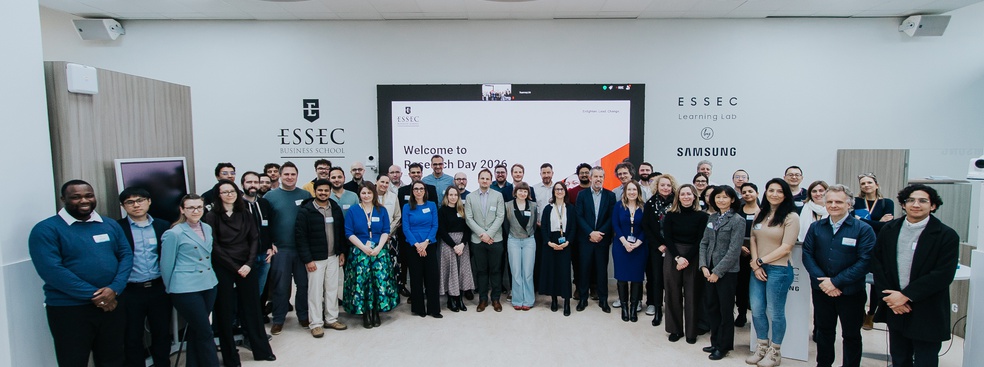
On February 5th, 2026, the ESSEC Research Centre held the 4th annual Research Day! Ha Hoang, Associate Dean of Research, welcomed faculty and other attendees to launch the day’s events.
.jpg)
Ha Hoang kicking off the day with an introductory speech.
Research Day provides an opportunity for professors and researchers to showcase their projects, receive and provide peer feedback, and foster interdisciplinary partnerships. This year’s edition included presentations from over a dozen ESSEC faculty members in France and Singapore, a PhD poster session, a roundtable discussion and a presentation from Matt Symonds of BlueSky Thinking. Ha Hoang notes, “Research Day lets researchers share their work, meet colleagues from other departments, and bounce ideas off one another - it’s just one of the ways we are building interdisciplinary collaboration at ESSEC.”
.jpg)
The ESSEC Research Centre.
Academic presentations
Does telling them you are doing good bring out the good in people?
Tuck Siong Chung, Associate Professor, Marketing, presenting virtually from the Singapore campus
This study examines how virtue signaling in job advertisements shapes recruitment outcomes for marketing positions. Drawing on signaling theory, we argue that the effectiveness of virtue signaling depends critically on the perceived costliness of the signal, such that recruitment success varies systematically across different categories of organizational virtues. We further hypothesize that signaling effectiveness is contingent on the characteristics of signal recipients—specifically, that the type of marketing role being filled moderates how job seekers interpret and respond to virtue-based signals. Finally, we investigate how broader labor-market sentiment conditions the returns to virtue signaling, recognizing that the signaling environment itself may amplify or attenuate its impact on recruitment outcomes. We empirically test our hypotheses using large-scale job-posting data combined with worker-level career and mobility data, enabling an analysis of signaling effectiveness across roles, time, and market conditions.
Importance weighted variational inference without the reparameterization trick
Kamelia Daudel, Assistant Professor, Information Systems, Data Analytics and Operations
.jpg)
Modern AI relies on sophisticated inference methods to extract patterns from data while managing uncertainty. Importance Weighted Variational Inference (IWVI) is a powerful tool for this task, yet its development, analysis, and widespread adoption are largely restricted to settings where the so-called reparameterization trick holds. However, the reparameterization trick assumption prevents the use of IWVI in many challenging applications, such as those found in Bayesian phylogenetics and state-space modeling. In our work, we provide the first rigorous theoretical analysis of IWVI without this assumption. Our results expose fundamental deficiencies in existing methods and guide the development of new, theoretically sound, and computationally efficient algorithms whose effectiveness is demonstrated empirically.
Intrafirm Knowledge Flows: How the Source of Knowledge and Status Shape Managers’ Knowledge Transfer Decisions
Anil Kshatriya, Assistant Professor, Accounting and Management Control
.jpg)
Effective knowledge sharing across units is essential for multi-unit firms to realize synergies, foster innovation, and avoid duplication of effort. Yet such sharing is often impeded by internal frictions, particularly when managerial incentives and motives are misaligned. This study examines how managerial knowledge-sharing decisions are shaped by two key factors: the source of knowledge (internally generated vs. externally acquired) and the presence of status-based recognition from corporate headquarters. I conduct a context-rich experiment in which managers decide whether to share knowledge that was either created internally or acquired externally, with or without symbolic recognition from headquarters. In the absence of recognition, managers are more willing to share knowledge they created internally than knowledge acquired externally. However, this preference is significantly reduced when headquarters offers recognition for sharing, indicating that such status-oriented incentives can effectively shift managerial focus from individual credit to collective outcomes. These findings reveal an important asymmetry in how knowledge flows within firms and highlight the potential of symbolic recognition to reduce internal competition and foster collaboration. The study offers implications for the design of management control systems that leverage reputational motives, rather than relying solely on financial incentives, to overcome information frictions in complex organizational settings.
Incentive Design for Human–AI Collaboration: Aligning Human Effort with Marginal Value
Shanming Liu, Assistant Professor, Accounting and Management Control, presenting virtually
Recent advances in artificial intelligence have fundamentally altered the nature of work, marking a shift from task automation toward integrated forms of human–AI collaboration. While such collaboration enhances productivity, accuracy, and clarity, organizations have struggled to realize its full potential, as both over- and under-reliance on AI often result in misallocated effort. Drawing on Holmström and Milgrom’s (1991) multitasking theory, we develop a framework for redesigning incentive systems in AI-enhanced work. We argue that incentives must be reweighted to direct human effort toward task dimensions where it has the highest marginal value, while reducing emphasis on AI-supported dimensions. In an experiment on creative proposal development, participants rewarded for novelty—where human input is critical—produced proposals rated higher in overall quality and originality, without sacrificing feasibility or clarity, compared to those rewarded for all dimensions through overall quality. Computational and process analyses confirmed that novelty incentives fostered deeper exploration and more varied collaboration with AI.
Creating and sustaining competitive advantage in the platform era: a theory of multi-platform firms
Jan Ondrus, Professor of Information Systems, Data Analytics and Operations, presenting virtually from the Singapore campus
We propose a theory of multi-platform firms, organizations that operate multiple interconnected digital platforms. Drawing on the theory of related diversification, we theorize how firms create and sustain competitive advantages by linking multiple digital platforms. Multi-platform firms develop three types of strategic digital assets that are imperfectly tradable, imperfectly substitutable, and imperfectly imitable: data, AI models, and digital services. By aggregating data across platforms, utilizing AI model inferences, and recombining digital services, multi-platform firms create competitive advantages over single-platform operators. To sustain these advantages, multi-platform firms employ two mechanisms. First, consumer steering involves linking platforms to nudge or coerce consumers from one platform to another, accumulating additional strategic digital assets. Second, asset self-reinforcement involves leveraging existing strategic digital assets to create new strategic digital assets that are immediately reusable across the platform portfolio. Our theory contributes to the information systems and management literature by moving beyond the single-platform focus that dominates current research and by providing a conceptual framework for understanding how the world's most successful big tech companies leverage their multi-platform portfolios to create and sustain competitive advantage.
A 28th Regime for European Innovative Companies
Paul Oudin, Assistant Professor of Law, Political Science and Society
.jpg)
The 2024 Draghi Report put forward numerous proposals to strengthen the European Union’s economic growth and capacity for innovation. Among them, the so-called ‘28th regime’, which entails the creation of a fully harmonised corporate form at the European level, proved especially popular. This paper questions the merits and feasibility of this project. After outlining the two prevailing conceptions of the 28th regime, it identifies three key regulatory challenges that European innovative companies face from a corporate law perspective: administrative burdens, rigid mandatory rules, and legal fragmentation. The paper then examines how these challenges can best be addressed. It argues that the establishment of a fully fledged European corporate form would encounter substantial political and technical barriers, and demonstrates that these problems could be resolved just as effectively through a series of targeted reforms benefiting existing national corporate forms.
Can Financial Hedging Mitigate Capacity Reallocation Triggered by a Large-Scale Supply Chain Disruption?
Andrea Roncoroni, Professor of Finance
.jpg)
Abstract. Prior work shows that integrated (financial–operational) risk management both improves firms’ risk-adjusted outcomes and facilitates higher operational commitments (inventory, production, and capacity). We add a third mechanism: integrated risk management can temper the operational retrenchment triggered by large-scale supply chain disruptions, modeled as exogenous deteriorations in supply-yield reliability. In a single-sourcing capacity allocation framework, we establish that large-scale supply chain disruptions lead to sharp capacity cutbacks, and that hedging instruments tied to supply-yield risk can materially offset these reductions, boosting resilience. By contrast, integrated risk management focused on demand-risk hedges may intensify the same cutbacks and thus undermine resilience. In a dual-sourcing extension, we show that a cross-hedge linked to gas supply-yield risk would have reduced the reshoring pressures induced by the 2022 disruption in the European gas sector following the Russo–Ukrainian war.
The distributional effects of low emission zones: Who benefits from cleaner air?
Lutz Sager, Assistant Professor of Economics
.jpg)
Low emission zones (LEZ) represent a key environmental policy instrument to address air pollution in cities. LEZs have reduced air pollution and associated health damages in regulated areas, but it remains unclear who has benefited from cleaner air. To examine the distributional effects of LEZs, we combine gridded data on resident characteristics, including income and a proxy for ethnicity, with high-resolution estimates of fine particle (PM2.5) concentrations in Germany, the country with the largest number of LEZs. We estimate heterogeneous treatment effects with a difference-in-differences approach and show that PM2.5 pollution reductions are distributed unequally across society. While residents with German name origins experience larger improvements within LEZs, residents with foreign names disproportionately live in LEZs and thus benefit more when assessed at a nationwide scale. Monetizing air quality benefits following governmental guidance, we find that they are distributed pro-poor within LEZs, disproportionately benefiting lower-income residents. From a nationwide perspective, however, benefits are distributed almost proportionally, while the sign is sensitive to how benefits from cleaner air scale with income. Overall, our results suggest that LEZs have nuanced distributional implications that differ sharply between a national perspective and local assessments that focus on effects within LEZs.
A spotlight on successful research grants
_(1).jpg)
Professors who received funding in 2025 pictured alongside the Grant Office and Ha Hoang, Associate Dean for Research.
As 2025 was a bumper year for research grants, laureates shared a glimpse of the projects they’re working on, their experiences with the application process, and how to work with the Grant Office. The session featured insights from ESSEC professors Diego Delle Donne, Giordano Mion, Marie-Léandre Gomez, Angela Sutan, Emiliano Traversi, Sofia Ramos, Alain Naef, and Felix Papier.
For more information on projects that received funding in 2025, check out these syntheses:
Thank you to session chairs Ha Hoang, Giordano Mion, Roberto Reno and Anne Jacqueminet!
Science communication
When Research Meets the Newsroom – A Guide to Amplifying Academic Impact in International Media
Matt Symonds, BlueSky Education, Founder and CEO; S of QS and former columnist for The Economist, BBC, Forbes, Bloomberg
This session explored how academic expertise and research can shift beyond journals to inform the international news cycle and influence global public debate, without sacrificing rigor or credibility. Drawing on Matt’s experience as the S of QS, and a former journalist for tier one global media, the session offered an inside view into how international media really works, and how faculty can engage strategically and effectively.
The interactive discussion demystified journalists’ priorities, constraints, and expectations, and explored how to identify the media-relevant insight in your research, translate complex ideas with clarity and precision, and build a credible public profile over time.
The workshop also addressed common concerns about media engagement, around misrepresentation, oversimplification, and time-commitment. Matt offered practical strategies to engage the media confidently, and with lasting impact. He emphasized the importance of being bold, of seizing the moment, and distilling your research into a memorable synopsis. Natalie Kettner, Director of Communications at ESSEC, also took to the stage to reiterate the key role that science communication plays in ESSEC’s strategy and to explain how the Communications team can help professors get the word out about their work.
.jpg)
Matt Symonds and Natalie Kettner discussing how professors can share their work.
A round table on rethinking knowledge across disciplines
With professors Lars Andraschko,Aurélien Colson, Noha El Attar,Paul Gouvard, Lutz Sager, and Radu Vranceanu
_2.jpg)
During the round table, moderated by Angela Sutan, ESSEC professors discussed the realities of interdisciplinary research, including the practical challenges of bridging academic silos. The participants shared experiences about working on interdisciplinary projects. Paul Gouvard noted that management is interdisciplinary by nature, rooted in psychology, sociology, and economics. He then presented a recent project combining organizational theory, the sociology of technology, and historical methods to examine how attributing an innovation to an innovator can shape the innovation itself, using the guillotine as a case. Lutz Sager discussed his research, covered above, and how it integrates atmospheric science with economics for pollution modeling.
The professors identified a pain point in conducting interdisciplinary research: the intellectual necessity of "cognitive interdisciplinarity"—redefining complex problems through multiple lenses—and the structural disincentives of academia, where tenure requirements and top-tier journals often favor narrow specialization. Noha El Attar offered an industry perspective, emphasizing a solution-oriented approach and the role of “knowledge brokers” bridging the gap between disciplines. She also noted that interdisciplinary projects in industry don’t always have time for a deep dive, as they need solutions and results more quickly.
Lutz Sager also advised identifying the outputs researchers hope to achieve from the outset, as those outputs can vary (for example, the type of journal being targeted). He also identified methodology and “conceptual language” as barriers, as researchers from different disciplines may not be familiar with one another’s methods and terminology. Aurélien Colson noted that it’s also about integrating people in addition to methods, and this requires significant socialization. Paul Gouvard noted that early-career researchers often face disincentives to interdisciplinarity, since journals and their audiences remain structured in disciplinary silos, but that the rewards can be substantial when interdisciplinary work yields truly novel theory and findings.
The panelists cautioned junior researchers about the risks of diluting their core expertise early in their careers. The professors discussed the value of a "slow science" approach that allows for genuine integration and a shift in how institutions value boundary-spanning work.
.jpg)
The day also featured PhD poster presentations.
_(1).jpg)
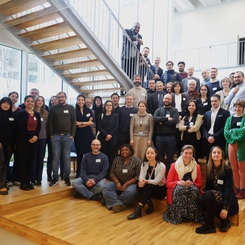
Thank you to all those who participated in Research Day!
To relive Research Day, check out recordings of all presentations here!