
by Radu Vranceanu
, 12.03.26
For much of the post-WWII era, Western governments perceived economic integration as a peace project. Freer trade promised prosperity, and, by raising the cost of war, stability. This logic shaped the European single market and the strategic opening to China. As global trade rose from 40% of GDP in 1980 to nearly 60% by 2010, many believed commerce had made international conflict obsolete.
History, however, tells a less comforting story. Economic dependence can deter war, but it can also be exploited. Long before globalization acquired its modern sheen, scholars such as Albert Hirschman warned that interdependence could become a liability. That insight is now staging a comeback. Since 2017, the liberal peace hypothesis is giving way to trade driven by national interest and increasingly following geopolitical block alliances rather than comparative advantage.
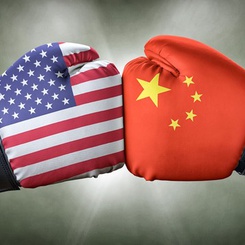
No relationship captures this shift better than that between the United States and China. After 2017, under the first term of Donald Trump, sweeping tariffs launched a decoupling drive, later reinforced by Joe Biden through subsidies and technology controls.The second mandate of Donald Trump pushed tariffs with China even higher. Chinese imports have fallen sharply as a share of American trade.
For many observers, the question is simple but puzzling: why would governments embrace policies that make everyone poorer?
Deterrence through decoupling
In a recent article in the Journal of Conflict Resolution (February 2026), Damien Besancenot (Université de Paris) and Radu Vranceanu (ESSEC Business School) offer a strategic answer based on insights from a standard “entry-deterrence” game. Economic decoupling, they argue, is not irrational. On the contrary, it can serve as a tool of deterrence.
They study a scenario where two superpowers with an integrated economy face the risk of conflict over a contested territory. War would inflict severe economic losses to both parties. A potential aggressor may exploit this, betting that the defender will avoid bearing such costs, and accept an unfavourable compromise, such as land sharing.
The defender’s threat to retaliate once that the attack is under way is therefore weak. This unfavourable position can be changed following the insights of the “credible threat” analysis by Thomas Schelling. By deliberately reducing economic dependence before any conflict occurs, the defender lowers the future cost of conflict. Thus separation hurts in peacetime, but makes resistance credible in wartime. Seeing this, the attacker may hold back. Decoupling thus works like a strategic investment, akin to sunk-cost entry barriers in industrial organization.
What level of separation is required?
The analysis of Besancenot and Vranceanu reveals that in a full-information setting, deterrence works only within a middle range of economic integration. If economies are barely connected, war is cheap and thus likely. If they are too intertwined, decoupling becomes prohibitively costly. Between these extremes lies an optimal degree of decoupling: just enough to make retaliation credible at minimal cost.
The picture darkens under imperfect information. When the attacker does not know how much the defender values the disputed territory, decoupling serves as a signal of resolve. But weaker types may imitate tougher ones, producing multiple equilibria, some peaceful, others risky. Small shifts in beliefs can suddenly make conflict more likely.
The lesson from their analysis is clear: economic separation can strengthen deterrence, but cannot eliminate war risk in the plausible context of incomplete information about the priorities of the defender.
A world catching up to the model
Reality increasingly mirrors this logic. America’s disengagement from China followed Beijing’s growing assertiveness toward Taiwan, and China accelerated military built-up in the Pacific. Economic pain, as imposed by Donald Trump on the US citizens through the high tariffs and other decoupling measures, might be now the price of credibility in any defense strategy toward China.
Europe learned a similar lesson after Russia’s invasion of Ukraine. Dependence on Russian energy, once assumed to deter conflict, proved a strategic vulnerability, one Vladimir Putin was hoping to exploit.
Decoupling is not protectionist folly. It is a sunk-cost investment in resolve. However, the “peace equilibrium” remains fragile. Where values are hidden and intentions uncertain, even costly separation cannot fully stabilize international relations.
Reference
Besancenot, D., & Vranceanu, R. (2026). Economic Decoupling as a Readiness Signaling Device. Journal of Conflict Resolution, https://doi.org/10.1177/00220027261426878